7 Pathways to Learn Auslan Sign Language in 2026
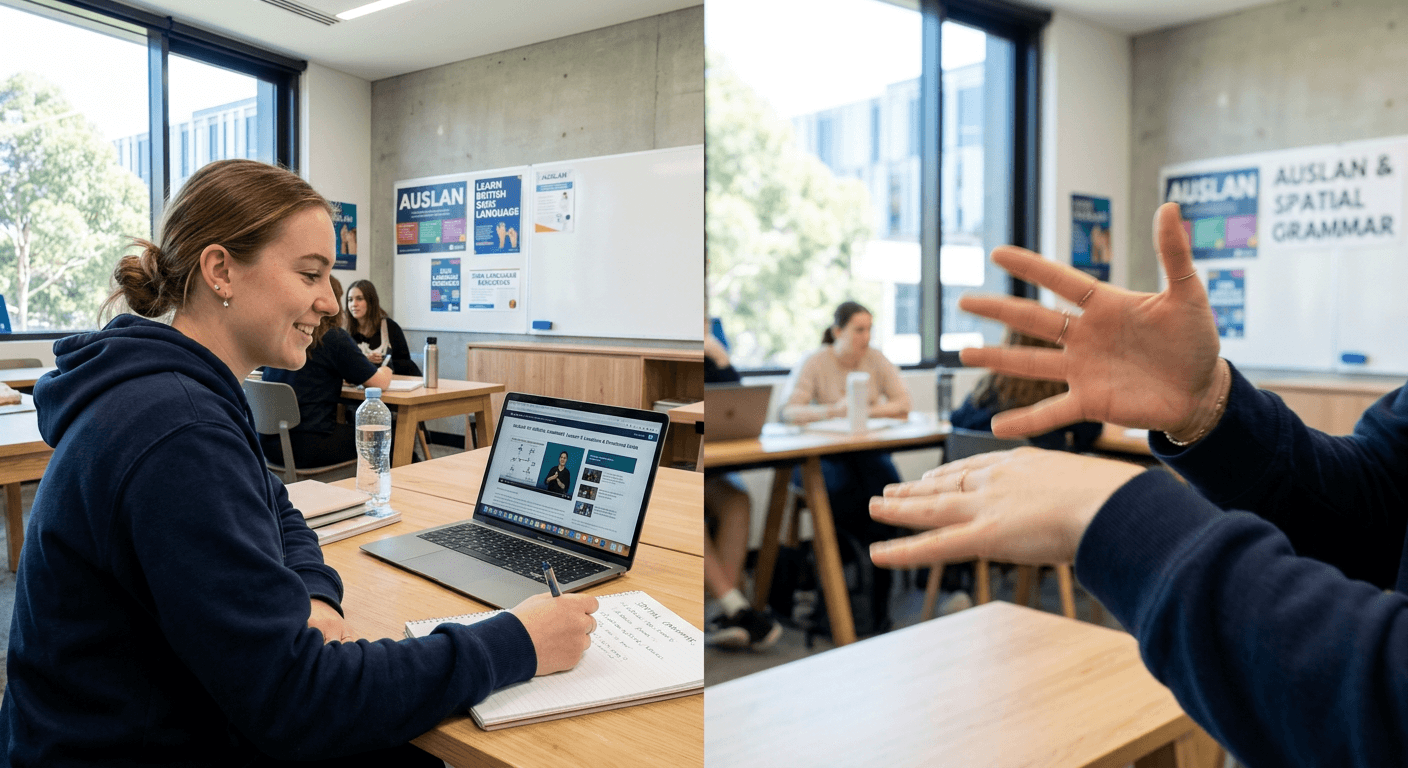
The most expensive assumption a healthcare or corporate facility can make is treating visual languages as interchangeable. This fundamental error reliably leads a well-meaning manager to book an asl interpreter for a local deaf patient, resulting in total communication failure at the exact moment clinical or legal accuracy is required. Navigating the available auslan sign language pathways requires acknowledging that Australian Sign Language is not simply English placed on the hands. It is a distinct, visual-spatial language belonging to the BANZSL family, complete with its own syntax, directional verbs, and complex facial grammar. Mastering it demands a clear-eyed look at how the language is actually acquired in 2026, and understanding the hard limits of each educational route.
Quick Summary
Auslan is the primary visual-spatial language of the Australian Deaf community, demanding an entirely different grammatical framework than spoken English. Acquiring it involves navigating varying levels of immersion, from digital vocabulary retrieval tools to multi-year vocational accreditations, each with strict ceilings on operational fluency.
- Formal vocational accreditation is non-negotiable for professional interpreting roles.
- Community courses cap out at basic workplace and social exchanges.
- Video dictionaries provide lexical reference but cannot teach spatial syntax.
- Native deaf tutors remain the most reliable source for correcting non-manual grammar.
Table of Contents
- Evaluating auslan sign language pathways
- 1. Accredited TAFE vocational certificates
- 2. Community short courses run by deaf societies
- 3. Digital video lexicons and linguistic databases
- 4. One-on-one coaching with native deaf signers
- 5. University linguistics programmes
- 6. Unstructured deaf community immersion
- 7. Asynchronous micro-learning applications
- Matching the pathway to your operational reality
- FAQ
- Recommended Reads
Evaluating auslan sign language pathways
Choosing how to learn depends entirely on the operational outcome you require. The resources below are judged against three critical criteria: the depth of grammar instruction, the presence of an interactive feedback loop (which is highly critical for visual languages), and the pathway to formal accreditation. A tool that excels at daily vocabulary acquisition will fail completely at building structural syntax.
| Pathway | Primary Focus | Best For | The Honest Limit |
|---|---|---|---|
| TAFE Certificates | Structural syntax and formal accreditation | Aspiring interpreters | Requires years of dedicated study |
| Community Courses | Basic greetings and deaf awareness | Frontline staff and family | Caps out at scripted conversations |
| Digital Lexicons | Vocabulary reference and dialects | All learners | Does not teach sentence construction |
| Private Tutors | Corrective feedback and spatial grammar | Intermediate learners | Prohibitively expensive for beginners |
| University Study | Theoretical linguistics and transcription | Researchers and educators | Minimal focus on rapid conversational speed |
| Community Immersion | Receptive speed and cultural adaptation | Advanced learners | Highly unstructured, relies on baseline etiquette |
| Micro-Learning Apps | Spaced repetition and casual vocabulary | Commuters and casual learners | Zero physical correction for bad habits |
1. Accredited TAFE vocational certificates
State-funded vocational education remains the structural backbone for individuals intending to pursue professional linguistic roles. This route is the exclusive pathway for anyone intending to become an accredited auslan interpreter in legal, medical, or government settings, demanding rigorous, sequential progression.
Delivery involves structured advancement from Certificate II through to Diploma levels over several years. Students are taught to discard English word order entirely, replacing it with visual-spatial grammar. Training focuses heavily on non-manual features (NMF) - using eyebrow raises, head tilts, and mouth morphemes to indicate questions, conditionals, or adjectives. Assessment is completely practical, requiring students to record expressive translations and complete live receptive exams under strict time pressure to prove structural competency.
Comprehensive syntax training with a heavy time penalty
The defining constraint of the TAFE pathway is its sheer duration and the accompanying attrition rate. Moving from a complete beginner to a professionally viable standard requires a minimum of two to three years of sustained, intensive study. If your operational requirement is simply enabling retail staff to greet deaf customers, this level of structural training is massive overkill. Furthermore, the rigid block-learning schedules often exclude full-time professionals from participating without substantial employer sponsorship.
Practical rule: Always budget double the classroom hours for independent receptive practice; watching native signers in varying contexts is where spatial syntax actually solidifies.
2. Community short courses run by deaf societies
Organisations like Deaf Connect facilitate short, term-based evening classes aimed at family members, hobbyists, and frontline staff who only need basic australian sign language to assist customers or colleagues in brief, predictable interactions.
Only native deaf signers run these seven-to-eight-week programmes. Students experience authentic language models from day one. The curriculum actively bypasses complex grammatical theory, focusing instead on immediate practical utility: fingerspelling, numbers, common workplace greetings, and essential deaf awareness protocols. Students practice in small groups. They learn the vital physical etiquette of gaining attention visually rather than auditorily, such as appropriate shoulder tapping or line-of-sight management.
Excellent for workplace basics, insufficient for fluency
You will not achieve true fluency through community courses alone. The syllabus caps out at highly predictable, scripted exchanges. Because these classes lack the rigorous assessment and forced progression of a vocational certificate, students often hit a hard plateau by the end of the second term. Without continuous, external engagement with the deaf community, the physical muscle memory required to sign smoothly fades rapidly once the course concludes.
3. Digital video lexicons and linguistic databases
The national standard for vocabulary lookup is the online auslan sign language dictionary, managed by linguistic researchers and continually updated to reflect modern usage. It serves as an essential reference tool for current students and working professionals needing to verify specific terminology.
Unlike a traditional printed dictionary, this database uses short video clips to demonstrate the precise handshape, location, and movement of a sign. Users can search by English equivalent or by handshape category. Crucially, the platform maps regional variations, showing exactly how a concept is signed differently in the Northern dialect (Queensland and New South Wales) compared to the Southern dialect (Victoria, South Australia, and Tasmania). It also categorises signs into technical fields, such as medical, educational, or legal terminology.
Perfect for vocabulary retrieval, useless for sentence construction
A dictionary is not a syntax engine. The most common failure mode for self-taught learners is searching for English words one by one and signing them in that exact order. This produces Signed English, a cumbersome hybrid that strips the language of its spatial efficiency and grammatical markers. Furthermore, a database cannot watch you sign; it cannot tell you that your thumb is slightly misplaced, unintentionally changing a professional greeting into an entirely different concept.
4. One-on-one coaching with native deaf signers
Direct private tutoring is an accelerated intervention built for intermediate and advanced learners who need to break through a receptive plateau or rigorously prepare for formal NAATI (National Accreditation Authority for Translators and Interpreters) testing.
Sessions are typically conducted via high-definition video links, forcing a strictly "voices off" environment. The tutor acts as a live diagnostic tool, isolating the student's specific mechanical errors. Instead of teaching new vocabulary, the focus shifts to spatial mapping - placing invisible objects in the signing space and interacting with them grammatically - and refining facial grammar. The immediate, corrective feedback loop breaks entrenched bad habits that easily slip past instructors in a crowded group classroom.
High-fidelity feedback at a premium price
This is a highly expensive way to learn the alphabet. Private coaching demands a solid foundational understanding to be economically viable; paying premium hourly rates for basic vocabulary acquisition is a profound waste of resources. Additionally, finding an available native signer with the specific linguistic skills required to diagnose grammatical errors - rather than just chat casually - can be exceptionally difficult outside major metropolitan hubs.
Practical rule: Never hire a hearing tutor for conversational fluency; native deaf signers provide the only reliable, authentic feedback on non-manual features and subtle facial grammar.
5. University linguistics programmes
Academic institutions, such as Macquarie University, offer dedicated streams within linguistics degrees focused entirely on the BANZSL family. This pathway is built for researchers, speech pathologists, and specialised educators who require a deep theoretical understanding of visual languages.
Learning the language is treated as just one component of broader sociolinguistic study. Students dissect the cognitive differences between processing visual and auditory information. The curriculum mandates learning transcription systems (such as ELAN), allowing students to break down a split-second sign into its exact hold and movement phases. It covers the history of deaf education, the long-term impacts of oralism, and the ongoing evolution of the language in the digital age.
Deep theoretical context, slower practical application
You will spend significantly more time writing academic papers about the language than physically communicating in it. The academic environment prioritises analytical understanding over raw conversational speed. If your sole objective is to deploy staff into a customer-facing role or confidently attend a community event, the academic pathway delays that outcome by forcing you through years of abstract linguistic theory.
6. Unstructured deaf community immersion
Attending deaf sports events, pub nights, and community barbecues provides raw, unpolished exposure. It is a mandatory proving ground for anyone serious about transitioning from classroom competence to real-world fluency.
Immersion forces the brain to abandon English completely. You are suddenly required to read signs delivered at native speed, often by individuals holding a drink, looking away, or signing with one hand. The environment teaches you to rely heavily on context clues and non-manual features rather than demanding perfect, textbook articulation. You learn the crucial environmental mechanics of visual languages: how to manage backlighting, when a waving hand means a casual greeting versus an urgent demand for attention, and how to successfully navigate visual noise in a crowded room.
Builds essential receptive speed, intimidating for novices
Community events are social gatherings, not unpaid language laboratories. Treating deaf individuals solely as free practice targets is widely considered highly offensive. Without a foundational grasp of basic etiquette and introductory conversational skills, attempting pure immersion will result in total isolation. No one is obligated to slow down, correct your grammar, or teach you basic vocabulary during their weekend downtime.
7. Asynchronous micro-learning applications
Mobile applications designed to help users learn sign language asynchronously are built specifically for daily commuters and casual learners attempting to build vocabulary through brief, gamified interactions.
These platforms segment learning into highly specific, functional categories (such as ordering coffee, navigating transit, or emergency medical terms). Users watch brief video clips and complete spaced-repetition quizzes to cement visual memory. The focus is exclusively on standard citation forms - how a sign looks perfectly executed in isolation, entirely stripped of conversational context, physical environment, or speed variations.
Low barrier to entry, zero corrective mechanics
The absolute lack of a mechanical feedback loop is a structural failure for acquiring any visual language. You can stare at a screen and mimic a sign, completely unaware that your palm is facing inward rather than outward, fundamentally altering the word's meaning. While apps maintain daily engagement and build rudimentary vocabulary, they actively calcify bad physical habits that a live instructor will eventually have to spend weeks dismantling.
Matching the pathway to your operational reality
Aligning your chosen method with your actual timeline and requirement prevents profound resource waste. If you are an individual wanting to connect with a deaf colleague, community short courses deliver exactly the baseline competence required. If you aim for a career in linguistics, the university pathway provides the necessary theoretical framework.
However, when organisational compliance, medical safety, or legal accuracy is on the line, the calculation shifts entirely. Attempting to train existing internal staff to the level of a certified sign language interpreter takes years and suffers from immense attrition. When immediate, high-stakes communication is required, bridging the gap with verified professionals is the only safe operational choice. Facilities managing urgent workflows routinely bypass the training lag entirely, relying directly on the LINGUA FRANCA HUB platform to secure on-demand, credentialed interpreting access exactly when the clinical or legal need arises. Waiting years for internal staff to qualify is not a viable strategy when a patient requires immediate diagnostic clarity today.
FAQ
Is Auslan directly interchangeable with ASL?
No. They are entirely separate languages belonging to different linguistic families. Auslan shares a lineage with British Sign Language (the BANZSL family) and utilises a two-handed alphabet, whereas American Sign Language stems from a French lineage and uses a one-handed alphabet. They are not mutually intelligible in any professional context.
How long does it take to achieve conversational fluency?
Reaching a point where you can comfortably navigate an hour-long, unscripted conversation with a native signer typically requires completing a Certificate III level accreditation combined with regular community immersion. For most adult learners, this represents roughly 12 to 18 months of consistent, weekly practice.
Can I learn entirely through online video platforms?
You can acquire baseline vocabulary online, but you cannot acquire spatial fluency without two-way feedback. Visual languages require constant physical corrections to handshape, location, and facial grammar that one-way video consumption simply cannot provide. A live, interactive element is mandatory for genuine acquisition.