Evaluating the best translation app options for mobile devices in 2026
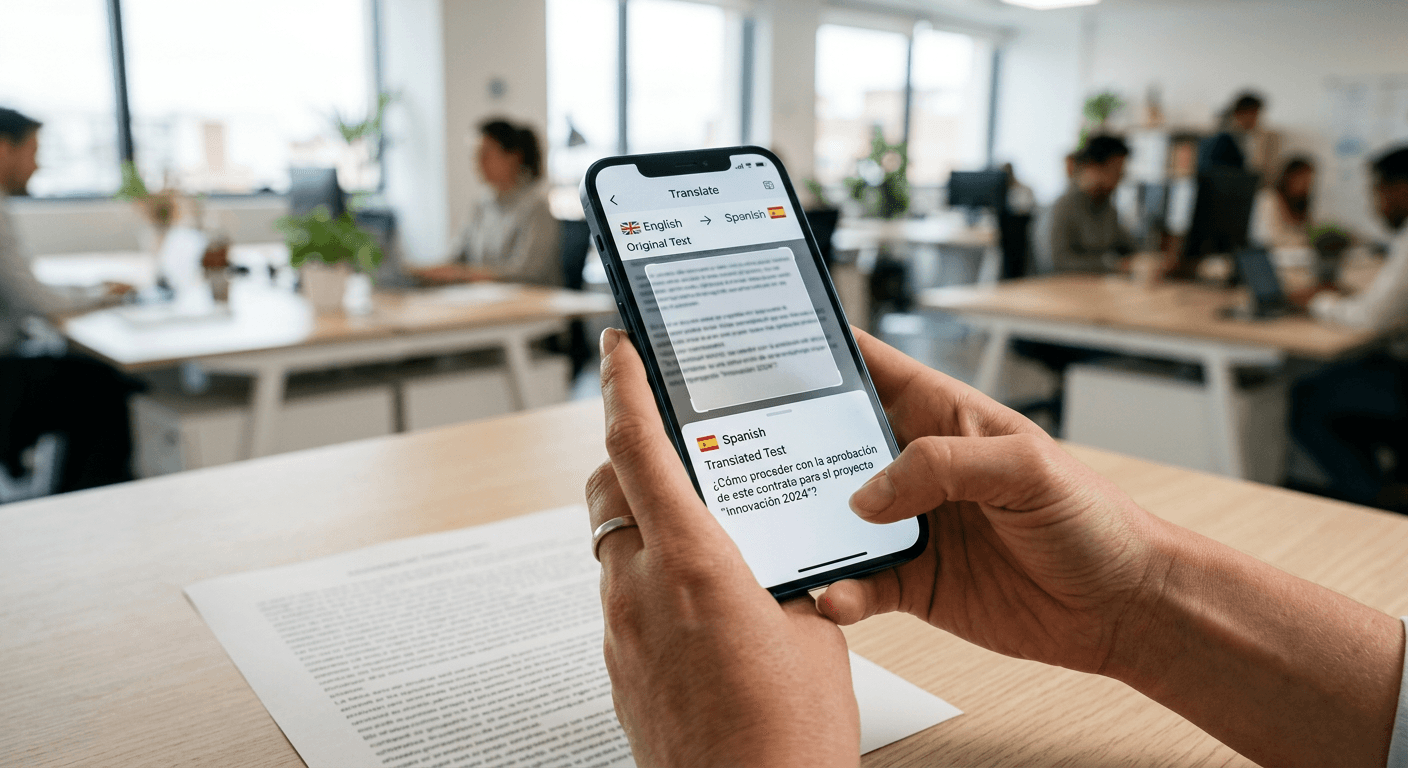
A clinician opens a consultation room door and sees a patient holding up a smartphone, expecting an automated voice to accurately relay a complex medical history. "The software gave me the exact words" is the wrong assumption most users arrive with when navigating language barriers. Accurate vocabulary delivered without situational nuance or cultural context is where communication breaks down entirely. Finding the best translation app for your specific use case requires understanding the hard boundaries between casual algorithmic wayfinding and the high-stakes demands of professional comprehension.
Quick Summary
A mobile translation app is a software utility that uses neural machine models to convert text, speech, or images between languages locally or via cloud processing. While excellent for surface-level travel tasks, algorithmic translation lacks the human context required for complex interactions.
- Local hardware constraints severely limit the vocabulary of offline neural translation models.
- Free tools frequently trade personal audio and text data for ongoing algorithm training.
- Algorithmic software cannot ask clarifying questions when source phrases are ambiguous.
- High-stakes environments require credentialed human interpreters, not consumer software.
Table of Contents
- The criteria that separate the best translation app from a liability
- 1. Google Translate
- Buying Guide / How to Choose
- The liability of relying solely on algorithms
- Mapping your exact bottleneck to the correct language tool
The criteria that separate the best translation app from a liability
Evaluating a language tool by counting its supported dialects ignores how the underlying technology actually functions. Mobile translation relies on Neural Machine Translation (NMT), a framework that predicts word sequences based on massive datasets rather than directly translating grammar rules.
The actual separator between tools is how they manage the processing load. Cloud-based translation sends your audio or text to a remote server. This provides the highest accuracy because the server can run enormous models without hardware constraints, but it introduces latency and requires a constant internet connection. On-device processing downloads a smaller, compressed version of the model directly to your phone. This removes the latency and the network requirement, but it forces the software to aggressively truncate its vocabulary and contextual awareness to fit within the memory limits of a mobile processor.
Before deploying any software, users must test its Voice Activity Detection (VAD) in a noisy environment. The algorithm must successfully isolate a human voice from background traffic or hospital monitors before the translation model even begins working. If the microphone array captures garbage audio, the neural model will confidently translate that garbage into another language, presenting a complete misunderstanding as a verified fact.
Comparison Table
| Product | Features | Pros | Cons | Target Audience |
|---|---|---|---|---|
| Google Translate | Translates text, handwriting, photos, and speech | Extensive language support, free to use, offline capabilities | Lacks contextual nuance, struggles with complex situational data | International travellers and users needing casual, surface-level translation |
1. Google Translate
Google's primary translation service operates as a multi-modal software tool capable of processing inputs across different formats. It is designed primarily for consumers and travellers who need immediate, functional understanding of their immediate environment, rather than certified accuracy.
The application relies on proprietary neural networks to parse inputs. When using the camera function, an optical character recognition (OCR) pipeline identifies the geometry of text in an image, extracts it, and feeds it into the translation model before overlaying the translated text back onto the screen. For spoken inputs, it converts audio to text, translates the text, and synthesises a voice output. Downloading the google translate app free from the App Store provides access to these features, where it currently shows a rating of 4.3 out of 5 from 584K ratings.
Massive language breadth relies on generalised training data
The platform translates text, handwriting, photos, and speech in over 200 languages. Supporting this volume requires zero-shot translation, meaning the algorithm occasionally translates between two languages without having been explicitly trained on that exact pairing, by routing the logic through a common intermediate language. Users looking for the best translator app free of subscription costs often default to this tool because of this sheer volume.
The honest limit of this approach is its total contextual blindness. The software processes sentences as isolated data points. If a user speaks a colloquialism, uses a culturally specific idiom, or relies on tonal inflection to convey urgency, the model strips that context away and outputs a literal, flat translation. It is strictly a one-way pipeline: the software cannot stop and ask the speaker to clarify an ambiguous pronoun or a slang term. Anyone requiring precise negotiation, clinical diagnostics, or legal documentation should skip this tool entirely, as the risk of a silent, unflagged mistranslation is absolute.
Pros:
- Processes camera inputs for real-time sign and menu translation.
- Allows users to download specific language packs for entirely offline use.
- Supports handwriting recognition for non-Latin scripts.
Cons:
- Fails to recognise or adapt to distinct regional dialects within a single language.
- Outputs literal translations that frequently miss the intended tone of the speaker.
- Requires high-quality audio input to prevent cascading transcription errors.
Buying Guide / How to Choose
Selecting a tool requires matching the technology to the specific environment where the communication breaks down. A tool that excels at translating a cafe menu will routinely fail when asked to navigate a commercial contract.
Evaluate the acoustic handling The primary appeal of an instant translation app is immediate vocal bridging. However, mobile microphones are omnidirectional. If you are standing on a busy street or in a crowded waiting room, the software will attempt to translate the background conversations alongside your own voice. You must test whether the application includes dedicated noise-gate filtering or if it requires you to speak directly into the device's receiver. Software without acoustic filtering is useless outside of a quiet room.
Understand the data trade-off When evaluating translator apps free of charge, users must recognise that the transaction is paid in data. Consumer-grade machine translation algorithms require continuous tuning, and user inputs are routinely logged, anonymised, and fed back into the training pipeline. If you use a free translation app to discuss a proprietary business timeline or a private medical symptom, that data is processed on external servers. Corporate and institutional users must verify a provider's privacy and data retention frameworks before speaking sensitive information into a microphone.
Assess the offline architecture Hardware dictates capability. If you are travelling to an area with poor network coverage, your tool must run entirely on the device. Check the file size of the offline language packs. A 50MB language pack relies on aggressive compression and a heavily restricted dictionary. It will handle basic nouns and verbs but will fail on complex grammar structures. It remains a functional baseline for anyone seeking the best free translation app for casual use, provided they understand that offline processing is fundamentally dumber than its cloud counterpart.
The liability of relying solely on algorithms
Machine translation reaches a hard stop the moment human welfare, legal standing, or commercial compliance is involved. Software is built to guess the most statistically likely meaning of a sentence; it is not built to guarantee factual accuracy.
In a clinical setting, a patient describing a "dull ache" versus a "sharp tear" requires precise interpretation. Algorithmic software frequently collapses these distinct descriptions into a single generic word for "pain". When a doctor relies on an app, they assume liability for any diagnostic failure caused by that algorithmic compression. The same absolute boundary exists in courts and corporate negotiations. Software cannot be subpoenaed, nor can it certify that a user fully understood the conditions of their visa or employment contract.
This is where technological routing must shift from algorithmic translation to human interpretation. Dedicated platforms facilitate video remote interpreting (VRI) and on-demand audio connections, treating the mobile device as a conduit to a real person rather than a standalone calculator. Depending on the stakes, institutions deploy credentialed professional interpreters for medical and legal exactness. For less critical but highly nuanced daily interactions - like settling into a new city or navigating an airport - casual bilingual assistance provides the cultural bridging that a machine fundamentally lacks. A human listener instantly recognises confusion, adapts to regional slang, and asks clarifying questions, ensuring the meaning is delivered rather than just the vocabulary.
Mapping your exact bottleneck to the correct language tool
No single tool resolves every language barrier. Deploying the wrong mechanism guarantees frustration and introduces severe operational risk.
If your bottleneck is static text - reading an international road sign, translating a cafe menu, or making sense of a foreign website - take a multi-modal software tool like Google Translate. Its OCR capabilities and offline noun databases are perfectly suited for surface-level, low-stakes comprehension.
If your bottleneck is a casual social interaction where tone matters but legal liability does not, an algorithmic tool will struggle. Navigating a housing inspection or setting up utility accounts in a new country requires understanding local conventions. In these scenarios, accessing peer-to-peer bilingual assistance ensures you understand the cultural context, not just the literal words.
If your bottleneck involves regulated environments, vulnerable populations, medical diagnostics, or binding commercial agreements, discard automated software entirely. The only defensible action is to secure a certified human interpreter. Software provides convenience, but only human comprehension provides verifiable certainty.