How to book an interpreter for complex medical, legal and business scenarios
Picture walking into a critical specialist medical consultation, only to find the patient has brought their teenage child to translate complex oncological terms. The risk of clinical misadventure skyrockets instantly. Relying on ad-hoc bilingual bystanders in high-stakes environments strips away accuracy, confidentiality, and professional boundaries. When you set out to book an interpreter, you are making a deliberate operational choice to mitigate risk and ensure equitable access to critical information. This process involves far more than simply finding someone who speaks two languages. It requires securing a credentialed professional who understands the specific terminology, cultural nuances, and operational protocols of your environment. Getting this right prevents systemic failures, protects vulnerable individuals, and keeps your organisation compliant with stringent industry standards.
Quick Summary
Booking an interpreter is the systematic process of sourcing, vetting, and securing a qualified language professional to facilitate accurate communication across distinct language barriers. Executing this correctly in medical, legal, or corporate settings prevents critical misunderstandings, ensures compliance with strict institutional requirements, and protects the integrity of sensitive information.
- Assess the operational risk to determine whether you require casual bilingual support or certified professionals.
- Choose between immediate video remote access and traditional pre-booked scheduling based on urgency.
- Match the specific regional dialect and cultural background to the client's actual spoken language.
- Configure your hardware and acoustic environment before the session begins to prevent technical dropouts.
Table of Contents
- 1. Evaluate the risk profile before you book an interpreter
- 2. Decide between on-demand access and scheduled appointments
- 3. Verify regional compliance and available state programs
- 4. Specify the exact dialect and cultural context
- 5. Secure the necessary technology and personnel
- 6. Establish ground rules at the start of the session
- Common Pitfalls & Troubleshooting
- FAQ
1. Evaluate the risk profile before you book an interpreter
High-stakes environments require strict credentialing
Not every language barrier requires the same level of intervention. The mechanics of sourcing interpreter services depend entirely on the consequences of a misunderstanding. In Australian legal tribunals, hospitals, and high-level corporate negotiations, precision is non-negotiable. These domains rely on practitioners holding specific credentials, such as NAATI (National Accreditation Authority for Translators and Interpreters) certification, which indicates the individual has passed rigorous testing in ethics and specialised vocabulary.
However, deploying a highly certified professional for a casual conversation - such as helping an international student navigate a local shopping centre or an airport - is an over-allocation of resources. In these low-risk scenarios, a highly proficient bilingual speaker acting as a casual language buddy is often more than sufficient.
The most frequent mistake organisations make at this stage is misjudging the required skill level. Facilities routinely book generalist bilingual staff for technical medical briefings, resulting in dangerous omissions when the worker encounters unfamiliar clinical vocabulary. You must audit the appointment type before initiating a search. Always verify how a platform handles sensitive data by reviewing the privacy policy before committing to a provider for confidential matters.
2. Decide between on-demand access and scheduled appointments
Video remote technology outperforms traditional scheduling for urgent matters
The traditional model of procuring interpreting services involved contacting an agency days or weeks in advance, requesting a physical practitioner, and paying minimum hourly block fees. While face-to-face scheduling remains useful for full-day court hearings or highly sensitive psychological assessments, it fails completely during emergent crises.
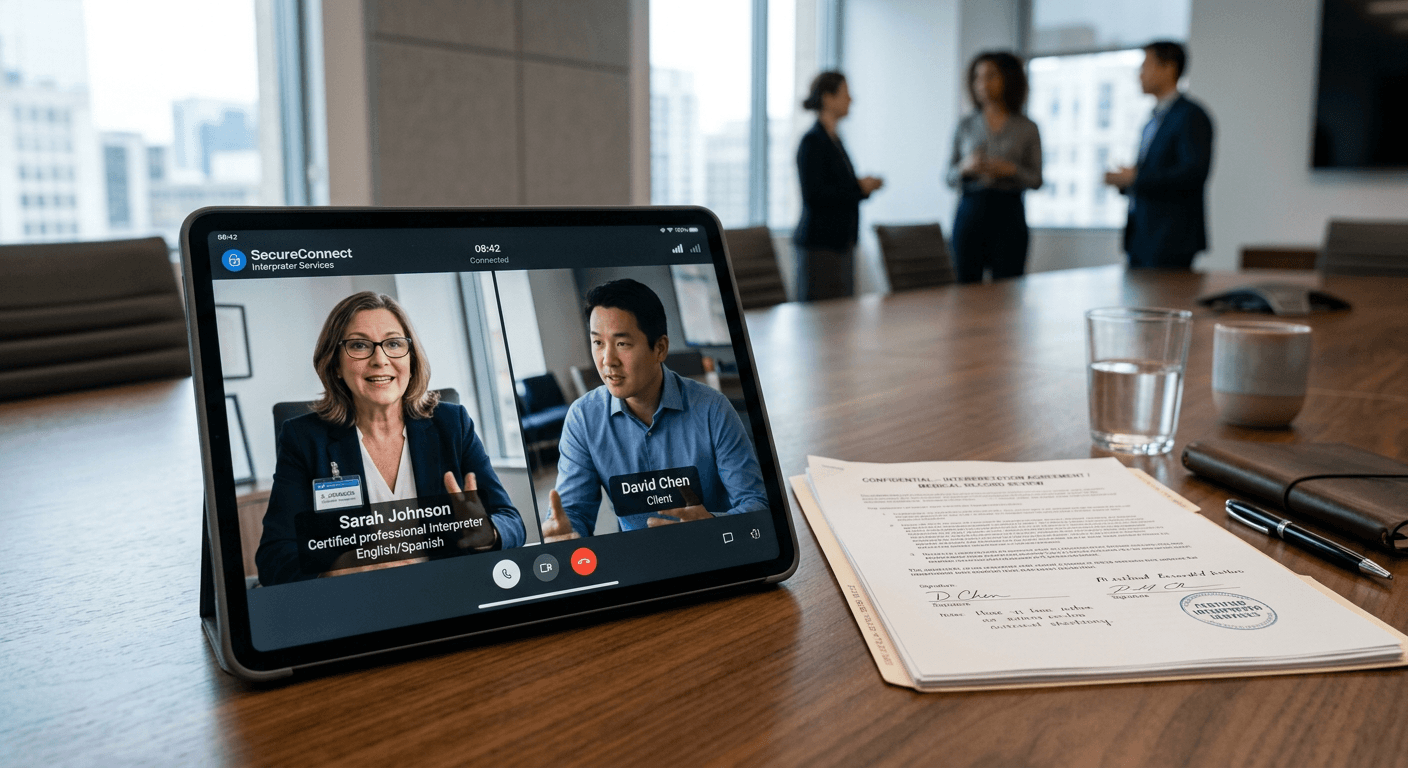
Modern systems operate closer to a rideshare model, routing requests to available professionals through an application interface. Video Remote Interpreting (VRI) and on-demand audio connections allow users to patch in a qualified linguist within minutes. This immediacy is critical in emergency departments, urgent police interviews, or spontaneous business negotiations where scheduling delays actively harm the outcome.
A common failure here is relying on traditional pre-booking for highly volatile environments. Clinic managers often wait hours for a scheduled physical arrival in an emergency room, unnecessarily delaying critical care. Using an on-demand interpreting platform like Lingua Franca Hub provides immediate access when time constraints prohibit waiting for an in-person arrival.
3. Verify regional compliance and available state programs
Local jurisdiction dictates funding and acceptable certification standards
Local frameworks control the administrative side of language access. Federal standards might dictate broad immigration protocols. However, state-based jurisdictions heavily influence how services are funded and delivered. Suppose you rely on a national interpreter service framework. You must still ensure the practitioner meets the specific requirements of the local administrative tribunal hearing your case.
When procuring interpreter services in Victoria, New South Wales, or other specific regions, local health departments and judicial systems maintain their own approved vendor panels and funding models for vulnerable populations, such as pensioners or those fleeing domestic violence.
Administrators often make one primary mistake. They assume a blanket federal qualification automatically satisfies a strict state-level procurement rule. Funding claims are routinely rejected. The booked professional was qualified. Yet they were not sourced through the mandated channel for that specific state department. Always cross-reference the practitioner's registration. Check it against the specific tribunal or health board's local guidelines before the session commences.
4. Specify the exact dialect and cultural context
Direct word-for-word translation fails without a cultural interpreter
Language is rarely monolithic. Requesting "Arabic", "Spanish", or "Chinese" without specifying the regional dialect is a logistical gamble. An Iraqi Arabic speaker and a Moroccan Arabic speaker will struggle to communicate effectively in a high-stress medical environment due to vast differences in regional vocabulary and syntax.
Beyond the mechanics of the dialect, sensitive interactions require a cultural interpreter - someone who understands the unstated social dynamics, stigmas, and non-verbal cues of the demographic. Direct, literal translation of mental health terminology or domestic violence concepts often yields nonsensical or deeply offensive results if the professional lacks cultural context.
The most common error in this phase is treating language as a simple checkbox. Case workers frequently book a linguist based on a broad national language, only to discover during a critical interview that the client speaks a hyper-local rural dialect.
Practical rule: Always ask the non-English speaker to name their specific dialect and region of origin, and confirm any gender preferences for the professional, before finalising the booking request.
5. Secure the necessary technology and personnel
Hardware and network failures ruin accurate interpretation
Even the most highly qualified linguist cannot translate what they cannot hear. When utilising remote solutions, the acoustic environment and the hardware infrastructure become the primary failure points. Ensuring you have the vital interpreting personnel on hand is useless if the connection suffers from severe latency, echo, or packet loss.
Simultaneous interpreting - where the practitioner speaks at the same time as the primary speaker - requires pristine audio fidelity. If the internet connection drops or the microphone picks up excessive background noise, the professional must constantly interrupt to ask for repetitions, destroying the flow of the conversation.
A frequent pitfall is executing high-stakes calls on mobile data in dense concrete buildings, such as hospital basements or courthouse holding cells. The signal inevitably degrades, leading to fragmented sentences and critical misunderstandings. Test the device on a stable Wi-Fi network in the exact room where the meeting will take place. Once your hardware is verified, ensure you have your credentials ready to access the account login portal smoothly when the appointment time arrives.
6. Establish ground rules at the start of the session
Speaking directly to the professional rather than the client breaks trust
The mechanics of conducting a mediated conversation dictate that the linguist acts as an invisible conduit, not an active participant. To maintain the relationship and trust between the primary parties, you must communicate in the first person.
This means looking directly at the non-English speaker and saying, "How are you feeling today?" rather than turning to the linguist and saying, "Ask him how he is feeling." The professional is trained to translate your words exactly as spoken.
The primary mistake users make is failing to brief all parties on the pacing of the conversation. Individuals often speak in long, unbroken paragraphs, expecting the linguist to memorise three minutes of dense technical information. This forces the professional to summarise rather than translate accurately. You must deliberately throttle your speech, pausing after every one or two sentences to allow for seamless, accurate conversion.
Common Pitfalls & Troubleshooting
Navigating language barriers introduces unique operational friction. Below are the most frequent breakdowns that occur during mediated sessions, what causes them, and how to resolve them immediately.
Symptom: The conversation is taking three times longer than expected, and the non-English speaker appears increasingly frustrated. Diagnosis: You are likely speaking in overly long paragraphs or using dense, culturally specific idioms that do not exist in the target language. The linguist is forced to spend excessive time deconstructing your analogies. Fix: Stop using local slang and metaphors. Break your communication down into single, distinct concepts and pause after every two sentences.
Symptom: The linguist repeatedly pauses to ask you for clarification on basic industry terms. Diagnosis: You have booked a casual language support worker for a highly technical or specialised briefing. This is the most common root cause of inaccurate translations in professional settings. Fix: Immediately halt the session if critical information is at risk. Reschedule the appointment and specify the need for a practitioner with documented credentials in that specific sector (e.g., medical or legal).
Symptom: Severe audio echoes and feedback loops are disrupting the video remote session, making it impossible to hear the translation. Diagnosis: Multiple devices in the same physical room are connected to the session with unmuted microphones, creating a hardware feedback loop. Fix: Ensure only one device in the room is handling the audio input and output. Mute all secondary laptops or smartphones instantly.
Symptom: The client appears confused or gives answers that do not logically follow your questions, despite the translation occurring smoothly. Diagnosis: There is a subtle dialect mismatch. The linguist is speaking a formal, national version of the language, while the client uses a regional or indigenous variant with different vocabulary. Fix: Ask the client directly (through the linguist) if they understand the specific dialect being spoken. You may need to source a new professional matching the client's exact home region.
FAQ
How far in advance should I arrange this service?
If you require an in-person professional for a highly specific niche dialect or a full-day legal hearing, you should finalise arrangements at least two weeks prior. For standard medical appointments or urgent corporate meetings, modern on-demand platforms can route you to a remote video or audio professional within minutes, eliminating the need for long-term scheduling.
What is the difference between a certified professional and a casual language buddy?
Certified professionals hold formal accreditation (such as NAATI) and are trained to handle complex terminology, ethical dilemmas, and strict confidentiality in high-stakes environments like courts and hospitals. Casual bilingual workers are highly proficient speakers best suited for low-risk, everyday interactions, such as navigating public transport, basic shopping, or casual social orientation.
Can I use a bilingual staff member instead of an external professional?
Using untrained bilingual staff for specialised translations is a massive operational risk. Staff members lack the formal training in consecutive translation, often omit critical details, and face severe conflicts of interest if delivering bad news. They should only be utilised for basic directional assistance, never for clinical, legal, or formal disciplinary conversations.
Who pays for the service in a healthcare or legal setting?
In Australia, funding structures depend heavily on the specific state and the individual's visa status. Many government agencies, public hospitals, and courts hold centralised accounts to cover the cost for vulnerable populations, pensioners, and humanitarian entrants. Private corporate clients and non-eligible individuals generally bear the cost directly through their chosen platform or agency.