How to Find Reliable Free Translation from Tagalog to English
A triage nurse holds up a smartphone to an elderly Filipino patient, relying on a browser tool to explain a hospital discharge. The patient looks confused, then alarmed. The tool has translated "discharge" not as a release from the hospital, but as a bodily fluid emission. This is the exact moment where relying on a free translation Tagalog to English tool shifts from a minor convenience to a critical failure. Tagalog is a highly contextual, affix-heavy language where a single root word changes meaning entirely depending on the prefix or suffix attached to it. When you need to bridge a communication gap without a budget, knowing which tool to use - and exactly where it will break down - is the only way to avoid catastrophic misunderstandings.
Quick Summary
Finding a reliable free English to Tagalog translation requires matching the tool to the task, as no single automated system handles Tagalog's complex verb focus and affixes perfectly.
- Machine translation engines handle simple, direct sentences but fail on cultural nuance.
- Corpus-based dictionaries provide accurate root-word breakdowns but require manual assembly.
- Large Language Models (LLMs) offer better conversational context but hallucinate idioms.
- Crowdsourced human forums provide the highest accuracy for slang but lack immediacy.
- High-stakes medical or legal scenarios always require human interpreters over free software.
Table of Contents
- The Evaluation Lens: Context vs. Speed
- 1. Google Translate
- 2. Bing Microsoft Translator
- 3. Tagalog.com Dictionary
- 4. Glosbe Translation Memory
- 5. ChatGPT Free Tier
- 6. Yandex Translate
- 7. Reddit r/Tagalog Community
- Summary Comparison
- Matching the Tool to Your Bottleneck
- FAQ
- Recommended Reads
The Evaluation Lens: Context vs. Speed
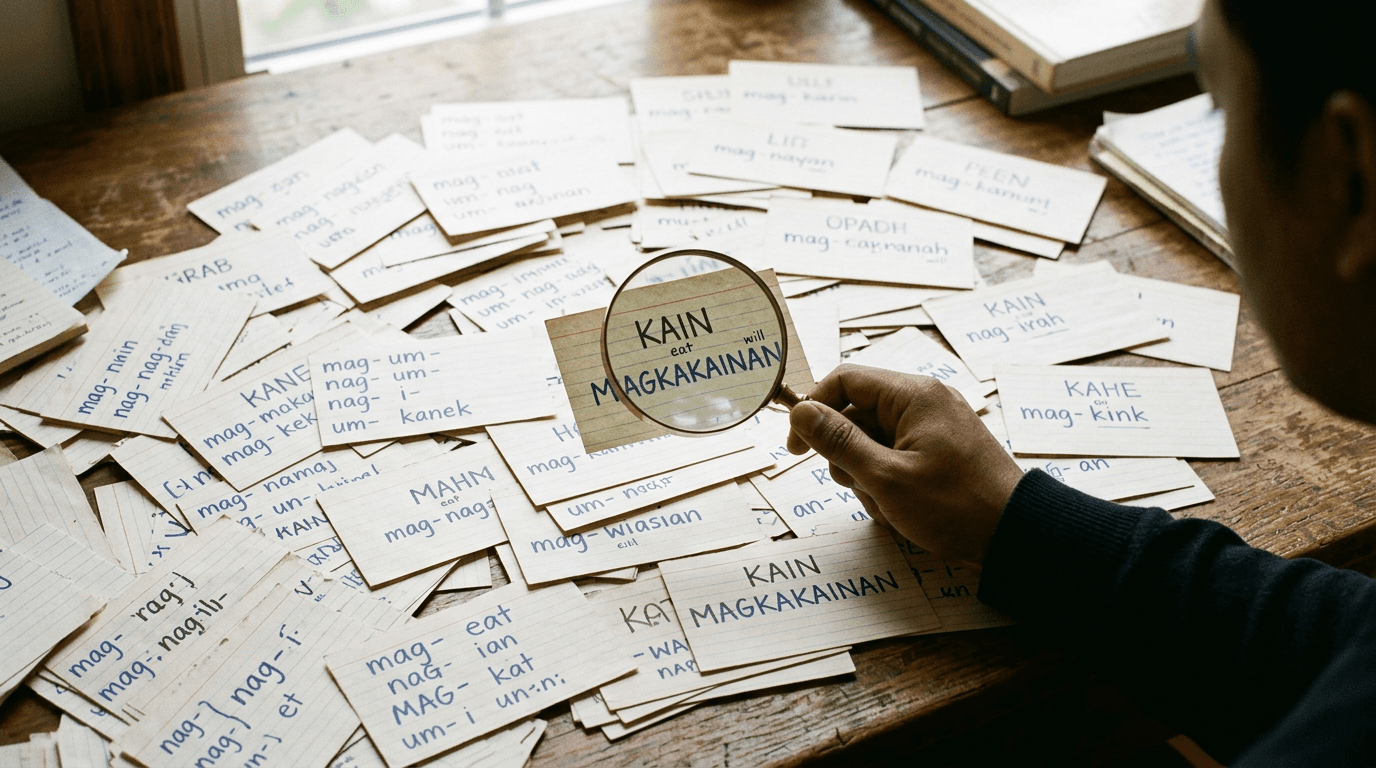
Before comparing specific platforms, you must establish the criteria for evaluating a free Tagalog to English translator. Tagalog relies heavily on a system of focus, where the verb changes depending on whether the actor, the object, or the location is the most important part of the sentence. A tool that translates word-for-word will strip this focus entirely, leaving a sentence that is technically translated but grammatically mangled.
We evaluate these seven resources on two strict criteria: morphological awareness (how well the tool understands root words and their attached affixes) and contextual retention (whether the tool remembers the subject of the sentence across multiple clauses). Tools that score high on speed usually fail on morphological awareness, while tools that excel at grammar require significant manual effort from the user.
1. Google Translate
Google Translate is a neural machine translation service that uses massive datasets to predict the most likely sequence of words between two languages. It is designed for users who need immediate, rough comprehension of a text or a quick way to generate basic phrases for travel or casual messaging.
The system works by mapping Tagalog sentences into a shared artificial language space and then decoding them into English. Because it relies on statistical probability rather than hard grammatical rules, it looks for patterns in its training data. If a specific Tagalog phrase appears frequently alongside an English phrase in its database, Google links them.
Broad vocabulary, poor affix handling
Google Translate is excellent at identifying nouns and common adjectives, making it highly effective for translating menus, basic signs, or simple transactional questions. However, it struggles severely with Tagalog's verb affixes (like mag-, um-, in-). It frequently misinterprets the tense or the actor of a sentence. For example, it might translate a sentence meaning "The child was fed by the mother" as "The child fed the mother" because it fails to parse the object-focus verb correctly. Anyone using this for complex instructions, particularly in healthcare or legal settings, should skip it entirely, as the risk of reversing the subject and object is too high.
2. Bing Microsoft Translator
Microsoft's translation engine is integrated into the Office suite, Edge browser, and a standalone mobile app. It targets business users, students, and travellers who need a free translation English to Tagalog tool that works seamlessly within their existing software ecosystem, particularly for translating emails or documents.
Bing uses a proprietary neural machine translation architecture that prioritises formal, structured text. It processes sentences by breaking them down into smaller tokens and attempting to maintain the formal register of the original text. It also includes a robust offline mode, allowing users to download language packs for use without an internet connection.
Stronger enterprise integration, rigid phrasing
Bing Translator handles formal documents slightly better than Google because its training data leans heavily on corporate and technical documentation. If you are translating a standard business email or a software manual, Bing often produces a more professional tone. The honest limit is its extreme rigidity. Tagalog is a dynamic language with a high degree of code-switching (Taglish). Bing struggles to process sentences that mix English and Tagalog, often freezing or producing nonsensical literal translations of slang. It is unsuitable for translating social media posts, casual text messages, or any communication that deviates from textbook grammar.
3. Tagalog.com Dictionary
Tagalog.com is a dedicated, corpus-based language resource built specifically for learners and linguists. It is not a simple copy-paste translation box; it is a comprehensive database of root words, affixes, and audio pronunciations. It is built for users who need to understand exactly why a word means what it means, rather than just getting a quick approximation.

The platform works by isolating the root word of any Tagalog input. When you search for a complex conjugated verb, the engine strips away the prefixes and suffixes, identifies the root, and then explains the specific conjugation used. It provides multiple example sentences for each word, showing how the meaning shifts depending on the context.
Unmatched grammatical depth, high user effort
This is the most accurate free Filipino to English translator resource available for single words and short phrases because it does not guess; it explains. It is the only tool on this list that will explicitly tell you if a verb is actor-focus or object-focus. However, it is terrible for speed. You cannot paste a 500-word document into Tagalog.com and get a translated page back. You have to look up words individually or in small clusters, making it a tool for decoding rather than bulk translation. It is strictly for users willing to invest time to ensure absolute accuracy.
Practical rule: When a machine translator gives you a sentence that feels grammatically backward, isolate the main verb and run it through a dedicated root-word dictionary to check the focus.
4. Glosbe Translation Memory
Glosbe operates as a crowdsourced translation memory rather than a pure machine translation engine. It is designed for researchers, translators, and bilingual professionals who need to see how a specific phrase has been translated in real-world documents, rather than relying on an algorithm's best guess.
Instead of generating new translations on the fly, Glosbe searches a massive database of parallel texts - documents that have already been translated by humans, such as UN transcripts, translated literature, and subtitled media. When you search for a phrase, it pulls up side-by-side examples of how that exact phrase was handled in existing bilingual texts.
Excellent real-world examples, inconsistent quality control
Glosbe's greatest strength is context. If you need to know how to translate a specific legal term or a medical condition, Glosbe will show you how professional translators have handled it in the past. This makes it invaluable for technical vocabulary. The limit, however, is the lack of curation. Because the database scrapes millions of documents, it occasionally pulls from poorly translated websites or automated subtitles. You must have enough baseline knowledge of the language to spot a bad example among the good ones. If you cannot verify the quality of the source document, you cannot trust the translation.
5. ChatGPT Free Tier
The free tier of OpenAI's ChatGPT (currently running GPT-3.5 or GPT-4o-mini) functions as a highly contextual translation engine. It is suited for users who need to translate conversational text, emails, or nuanced paragraphs where tone and intent matter more than literal word-for-word accuracy.
Unlike traditional machine translators that process text sentence by sentence, LLMs process the entire prompt as a single context window. You can instruct the model to "translate this Tagalog text to English, keeping the tone casual and explaining any cultural idioms." The model predicts the next best token based on the parameters you set, allowing for dynamic adjustments to formality and style.
Superior conversational flow, prone to over-formalisation
ChatGPT is currently the best automated tool for handling Taglish (the mixing of Tagalog and English) because it understands conversational context better than rigid translation engines. It can smooth out awkward phrasing and deliver highly readable English. However, the model frequently over-formalises or hallucinates. If it encounters a highly specific regional slang term it does not know, it will often invent a plausible-sounding but entirely incorrect English equivalent rather than admitting it doesn't know. It requires strict prompting to prevent it from rewriting the text into a generic, overly polite corporate tone.
6. Yandex Translate
Yandex Translate is a Russian-developed machine translation engine that has built a surprisingly robust database for Southeast Asian languages. It is primarily used by individuals looking for an alternative to Google or Microsoft, particularly when dealing with large blocks of text or entire website translations.
It uses a hybrid model, combining statistical machine translation with neural networks. Yandex is particularly aggressive in its predictive text algorithms, attempting to smooth out grammatical inconsistencies in the source text before translating it into the target language.
Aggressive predictive text, weak regional nuance
Yandex often produces highly readable English sentences from Tagalog input, sometimes reading more naturally than Google Translate. It is useful for getting the general gist of a news article or a blog post. However, its aggressive smoothing algorithm is its biggest flaw. If a Tagalog sentence is ambiguous, Yandex will confidently guess the meaning and present it as fact, completely erasing the ambiguity. It also has very weak support for regional variations of Tagalog or words borrowed from other Philippine languages (like Cebuano or Ilocano), often translating them as gibberish.
7. Reddit r/Tagalog Community
The r/Tagalog subreddit and similar language exchange forums are human-powered translation resources. They are for users who have encountered a phrase, idiom, or cultural reference that machine translation completely fails to process, and who need a native speaker to explain the nuance.
Users post their translation requests, and bilingual community members provide translations, often breaking down the grammar and explaining the cultural context behind the phrase. It operates entirely on volunteer effort and community moderation.
Perfect cultural accuracy, zero immediacy
This is the only free resource that can accurately translate deep cultural idioms, highly specific slang, or emotionally complex poetry. A human native speaker can tell you that a specific phrase is technically correct but sounds sarcastic in context - something no machine can do. Relying on volunteer internet forums inevitably introduces significant delays. You might wait hours or days for a response, and there is no guarantee that the person responding is actually a qualified linguist. It is entirely useless for live conversations, urgent medical situations, or immediate business needs.
Summary Comparison
| Resource | Best For | Mechanism | The Honest Limit |
|---|---|---|---|
| Google Translate | Quick, basic vocabulary | Neural machine translation | Fails on complex verb affixes and focus. |
| Bing Translator | Formal business text | Token-based neural translation | Cannot handle Taglish or casual slang. |
| Tagalog.com | Deep grammatical study | Corpus-based root dictionary | Requires manual, word-by-word effort. |
| Glosbe | Technical/Legal terms | Translation memory database | Pulls from unverified, sometimes poor sources. |
| ChatGPT | Conversational tone | Large Language Model | Hallucinates idioms and over-formalises. |
| Yandex | Bulk text reading | Hybrid statistical/neural | Erases ambiguity with aggressive guessing. |
| r/Tagalog | Cultural idioms | Human crowdsourcing | Zero immediacy; relies on volunteers. |
Matching the Tool to Your Bottleneck
Choosing the right tool depends entirely on where your communication is breaking down.
If your bottleneck is understanding a formal document or a news article, use Bing Translator or Yandex to get a readable overview. If you are trying to learn the language and need to understand why a specific verb was used, Tagalog.com is the only tool that will give you the mechanical breakdown you need. If you are dealing with casual text messages heavily mixed with English, ChatGPT will provide the most natural-sounding result.
However, if your bottleneck involves high-stakes communication - such as explaining a medical diagnosis, navigating a legal dispute, or conducting a critical business negotiation - none of these free tools are sufficient. Machine translation cannot read a room, cannot verify comprehension, and cannot be held liable for errors. In these scenarios, relying on free software is a liability, and securing professional human interpreting services is the only viable operational choice.
FAQ
Can I use free translation tools for medical or legal documents?
No. Free translation tools lack the contextual awareness and accountability required for high-stakes environments. They frequently mistranslate critical verb focuses in Tagalog, which can reverse the meaning of a sentence entirely.
Why do machine translators struggle with Tagalog verbs?
Tagalog uses a complex system of affixes (prefixes, infixes, and suffixes) that change the focus of the sentence to the actor, object, or location. Machine translators often strip these affixes, losing the core meaning of who is doing what to whom.
Is ChatGPT better than Google Translate for Tagalog?
ChatGPT is generally better at handling conversational Tagalog and Taglish (mixed Tagalog and English) because it processes the entire context of a prompt. However, Google Translate is faster for single-word lookups and basic nouns.
How can I verify if a free translation is accurate?
Isolate the main verbs and run them through a dedicated root-word dictionary like Tagalog.com to ensure the tense and focus match your intended meaning. Alternatively, cross-reference the phrase in a translation memory like Glosbe.