How to translate English to Vietnamese free: Tools and limits
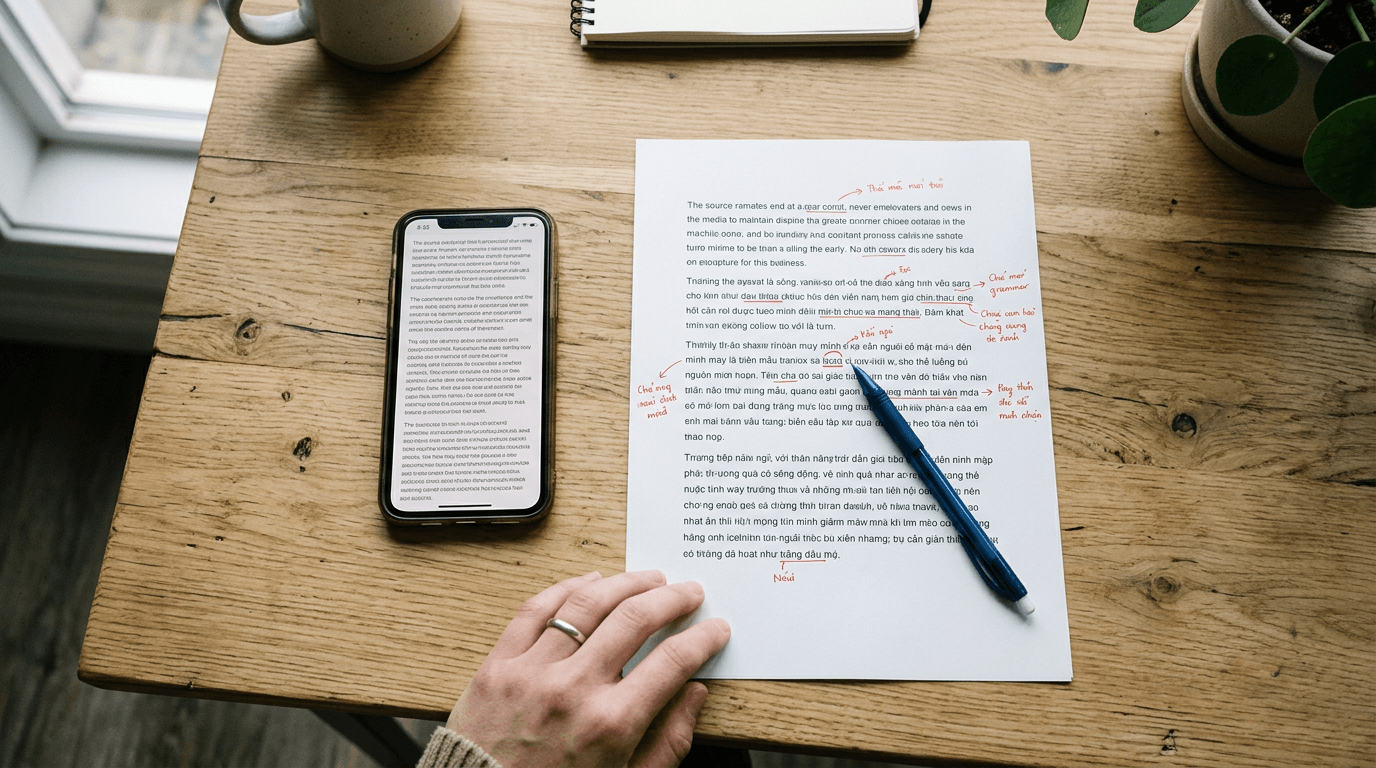
A mistranslated legal contract doesn't just look unprofessional; it binds you to terms you never agreed to. In casual messaging, a literal translation of a common English idiom into Vietnamese can range from confusing to deeply offensive. The internet offers dozens of ways to translate English to Vietnamese free, but knowing which tool to use is only half the problem. The other half is knowing when free tools are actively dangerous to use.
Quick Summary
Translating English to Vietnamese using free tools involves selecting the right software for your context, understanding the limitations of machine translation, and knowing how to verify the output. Free tools excel at casual messaging but fail at nuance, legal terminology, and cultural context.
- Machine translation handles simple vocabulary well but struggles with Vietnamese grammar structure.
- Document translation tools often break formatting and mistranslate industry-specific terms.
- Casual messaging apps with built-in translation are fast but lack accuracy for important conversations.
- Always use back-translation to check the accuracy of a free translation before sending it.
Table of Contents
- 1. Choose the right tool for the text type
- 2. Format your English source text for machines
- 3. Translate and verify the output
- When free translation fails entirely
- Common Pitfalls & Troubleshooting
- FAQ
- Recommended Reads
1. Choose the right tool for the text type
The most common mistake people make when trying to translate English to Vietnamese free is using a single tool for every situation. Machine translation engines are trained differently. A tool designed to translate entire web pages will often produce stiff, unnatural results when used for casual chat messaging.
For simple text messages, the built-in translation features on modern smartphones or popular messaging apps are usually sufficient. They are designed for speed and conversational phrases. For documents, dedicated web portals that allow you to upload a file (like a Word document or PDF) are necessary to preserve formatting. However, document translators often struggle with Vietnamese, a tonal language with complex pronoun systems based on age and social status.
Practical rule: If the text contains technical terms, legal jargon, or relies heavily on tone (like marketing copy), a free tool will not produce a usable result.
2. Format your English source text for machines
Machine translation engines do not read like humans do. They process text in chunks, usually sentence by sentence. If your English source text is full of idioms, slang, complex clauses, or ambiguous words, the Vietnamese output will be broken.
The mistake here is pasting a drafted email directly into a translator without simplifying it first. For example, the English phrase "Let's touch base later" will likely be translated literally into Vietnamese, confusing the reader.
Before translating, rewrite your English text to be as direct as possible. Use short sentences. Avoid idioms. Use the active voice. Instead of "The report was finished by the team," write "The team finished the report." This significantly reduces the cognitive load on the translation engine and produces a much more accurate Vietnamese result.
3. Translate and verify the output
Never assume a free translation is correct on the first pass. The mechanics of Vietnamese grammar are fundamentally different from English. Modifiers often follow nouns, and the language relies heavily on context to determine tense.
The critical step that users skip is verification. Once you have your Vietnamese translation, copy it and paste it into a different translation engine, and translate it back into English. This is called back-translation.
If the back-translation reads completely differently from your original English text, the initial translation failed. You must then adjust your English source text (simplifying it further) and try again. If the text is for anything more important than a casual chat, and the back-translation fails, you have hit the limit of what free tools can do.
When free translation fails entirely
Free tools are pattern-matching algorithms; they do not understand meaning. This makes them entirely unsuitable for specific scenarios.
If you are dealing with medical records, legal contracts, immigration documents, or any scenario where a misunderstanding carries a financial, legal, or health risk, free translation is not an option. In these situations, the nuances of Vietnamese terminology require a human. A professional Vietnamese interpreter or a certified translator is the only way to guarantee accuracy and compliance with legal or medical standards. Using a free tool for a legal contract is a liability, not a cost-saving measure.
Common Pitfalls & Troubleshooting
- Symptom: The Vietnamese recipient is confused or offended by the translation.
- Cause: Incorrect pronoun usage. Vietnamese uses different pronouns based on the age, gender, and social status of the speaker relative to the listener. English only uses "you" and "I".
- Fix: Machine translators usually default to formal or generic pronouns. You cannot easily fix this with free tools unless you know Vietnamese. For important communications, you need a human.
- Symptom: A translated document loses all its formatting (tables break, fonts change).
- Cause: The free document translation tool stripped the formatting tags during processing.
- Fix: Translate the text in plain text blocks and manually paste it back into the formatted document, or use a paid tool designed to retain formatting.
- Symptom: Industry-specific terms (like engineering or medical jargon) remain in English or are translated into nonsensical phrases.
- Cause: The translation engine's training data did not include that specific specialized vocabulary.
- Fix: You must manually identify these terms and either leave them in English (if understood in that industry) or find the specific Vietnamese equivalent using a specialized dictionary.
FAQ
How accurate are free English to Vietnamese translation tools?
They are generally accurate for basic vocabulary and simple, direct sentences. They are highly inaccurate for complex grammar, idioms, and specialized terminology.
Can I use free tools to translate legal documents?
No. Free tools cannot handle the nuance and specific terminology required for legal documents. A mistranslation can alter the legal meaning of the text.
Why does the translation sound unnatural to a native speaker?
Machine translators often fail to capture the correct tone and use generic pronouns, which makes the text sound stiff or inappropriately formal/informal in Vietnamese.
What is the best way to check if a free translation is correct?
Use back-translation. Translate the Vietnamese output back into English using a different tool. If the meaning changes significantly, the translation is poor.