Learn Sign Language: 5 Education Pathways Explored
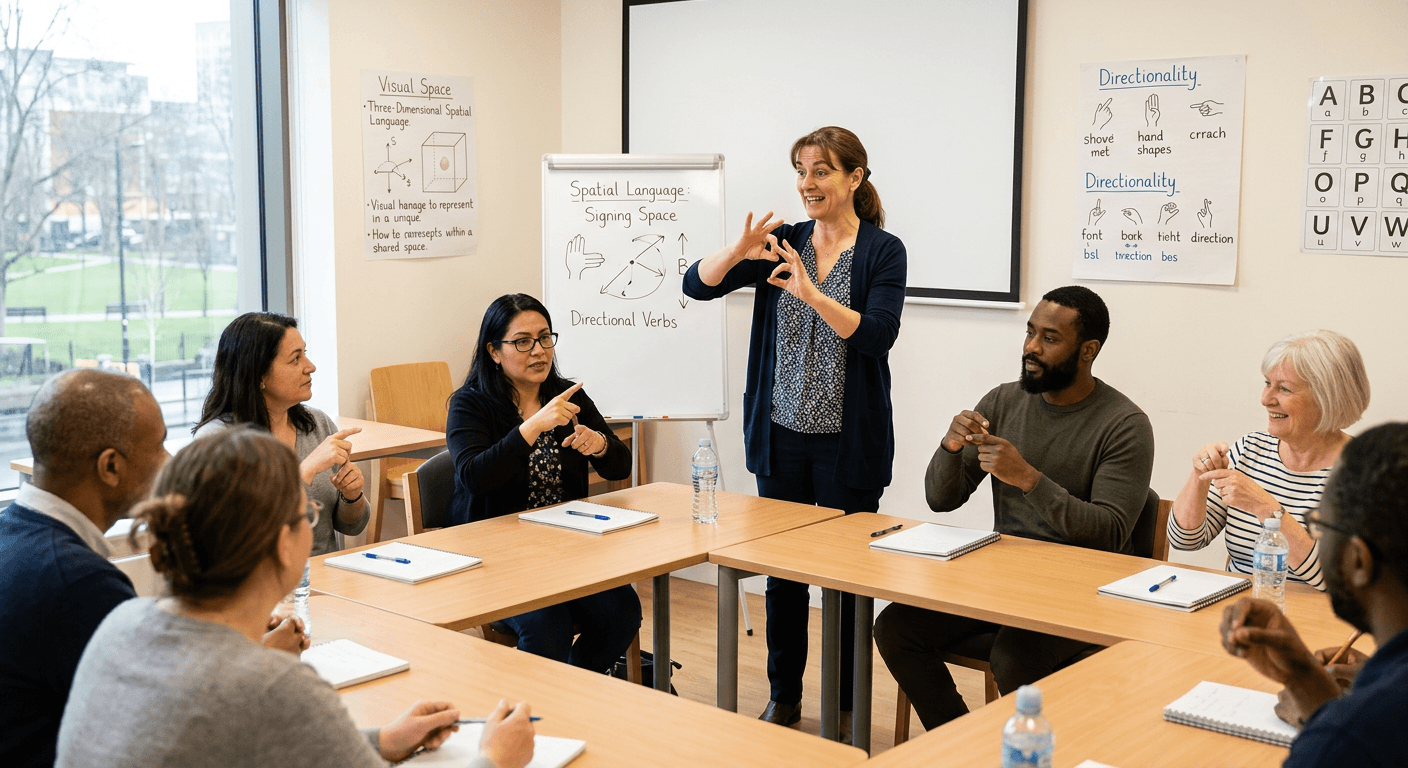
A persistent misconception for hearing adults is that visual communication is a universal code, entirely transliterated from spoken English. Newcomers routinely enrol in classes expecting to acquire a global set of hand gestures, only to discover that visual languages are regionally distinct, culturally bound, and syntactically independent from the spoken words around them. Auslan shares no grammatical root with spoken English, and American Sign Language shares little vocabulary with British Sign Language. If you intend to learn sign language, the primary challenge is not just memorising vocabulary, but determining which dialect, system, and educational setting actually aligns with your local environment and professional demands.
Quick Summary
Signing education encompasses a spectrum of pathways ranging from casual community classes to rigorous tertiary credentials. Choosing where to learn sign language dictates whether you acquire a basic conversational foundation for social interactions or the precise linguistic and cognitive frameworks required for professional, high-stakes interpreting.
- Community societies offer authentic immersion for foundational local vocabulary and cultural integration.
- Tertiary degrees are legally mandatory for credentialed professional interpreting in medical and legal settings.
- Self-paced digital courses provide basic vocabulary but lack the real-time non-manual feature correction necessary for fluency.
- Private tutoring accelerates specific lexical acquisition but risks isolating the learner from diverse regional dialects.
- Specialised workshops teach contact pidgins for transnational events, though they do not replace foundational native languages.
Table of Contents
- Quick Summary
- Choosing How to Learn Sign Language
- 1. State-Based Deaf Societies and Community Classes
- 2. Tertiary Education and Diploma Programs
- 3. Asynchronous Online Courses
- 4. Private Bilingual Tutoring
- 5. Transnational and NGO Workshops
- Mapping the Pathways to Your Bottleneck
- FAQ
- Recommended Reads
Choosing How to Learn Sign Language
Before committing to a curriculum, you must evaluate two distinct criteria: feedback immediacy and linguistic depth. Feedback immediacy refers to how rapidly a native signer can correct your spatial and physical errors before they become ingrained muscle memory. Linguistic depth measures whether a program stops at conversational pleasantries or pushes into the rigorous cognitive processing required for simultaneous translation.
Evaluating pathways against these criteria prevents the common error of spending years in a community setting only to find you lack the legal credentialing for professional work, or conversely, paying for intense tertiary training when you merely wanted to communicate with a neighbour.
| Education Pathway | Primary Audience | Feedback Immediacy | Terminal Capability |
|---|---|---|---|
| Community Classes | Adult beginners, families | High (Group setting) | Conversational fluency, cultural awareness |
| Tertiary Programs | Future interpreters | High (Clinical practicums) | Professional interpreting credentials |
| Online Courses | Remote learners, hobbyists | None | Rote vocabulary recognition |
| Private Tutoring | Specialised professionals | Very High (1-on-1) | Accelerated, domain-specific fluency |
| Transnational Workshops | Global event delegates | Moderate | Transnational functional communication |
1. State-Based Deaf Societies and Community Classes
State and national deaf advocacy organisations provide structured, face-to-face courses aimed at adult beginners, families of newly diagnosed deaf children, and immediate community members. These are the traditional entry points for foundational, regional vocabulary and represent the most culturally integrated method of early learning.
Instruction typically follows a strict "voices off" methodology from the very first session. Tutors, who are native deaf signers, remove spoken language from the room entirely. This forces students to rely on spatial awareness, facial expressions, and physical mimicry to communicate basic concepts. By stripping away auditory crutches, this immediate immersion forces the hearing brain to process information visually. Students progress through graded certificate levels that expand their vocabulary from basic greetings to recounting complex past events, all while interacting directly with active members of the local deaf community.
Authentic cultural exposure lacks advanced professional rigour
The practical limit here is professional progression. Community classes are explicitly designed for social integration, meaning their curriculum prioritises conversational stamina over cognitive translation endurance. They will not qualify you to interpret in high-stakes environments. If your goal is formal credentialing, or you are specifically trying to locate a sign language course Perth educators run for immediate workplace legal compliance, you will find that these community pathways stop short of the necessary professional certification. You will graduate as a competent conversationalist, not a qualified practitioner.
2. Tertiary Education and Diploma Programs
University degrees and vocational diplomas cater exclusively to individuals seeking careers as credentialed, professional interpreters. This is the mandatory, regulated pipeline for high-stakes institutional work in courtrooms, hospitals, and corporate boardrooms.
This goes beyond merely expanding an individual's vocabulary. Tertiary programs focus intensely on cognitive processing, ethical boundaries, and linguistic theory. Students undergo rigorous drills in consecutive and simultaneous interpreting. They learn to manage "decalage". This is the deliberate processing lag between receiving a signed concept and reproducing it accurately in spoken English. Practicums mandate supervised translation in simulated clinical settings. These forge working memory under pressure. The curriculum also strictly covers practitioner ethics. This ensures students understand how to remain neutral facilitators rather than active participants in a dialogue.
Practical rule: Select a tertiary pathway only if your end goal is formal accreditation and professional employment; the curriculum is designed to produce clinical practitioners, not casual conversants.
The only reliable route to credentialed interpreting
This route demands a massive commitment of time and capital. It often takes two to three years of full-time study. Some merely want to connect with a deaf colleague. Others aim to navigate casual social interactions. For them, the intense focus on cognitive processing theory, legal liability, and interpreting ethics will prove overwhelming and unnecessary. It is entirely unsuited for hobbyists. It also fails professionals who need a rapid acquisition of basic workplace vocabulary.
3. Asynchronous Online Courses
Pre-recorded digital video modules serve self-paced learners who lack the time, budget, or geographic proximity to attend physical classes. They are highly popular for initial curiosity, remote study, and low-stakes corporate diversity training.
Learners progress through extensive video libraries, watching demonstrations of distinct signs and repeating them in isolation. Whether you are enrolling in an American sign language course or an introductory Auslan module, the core mechanism relies entirely on visual repetition and self-correction. The learning is often aided by digital flashcards and multiple-choice quizzes that test passive visual recognition rather than active, physical production. Students can pause, rewind, and practice entirely on their own schedule.
High accessibility masking low structural correction
This format entirely misses the spatial and non-manual features (NMFs) of the language, which are the fundamental building blocks of visual grammar. You might learn how to say sign language in ASL, but without a native tutor actively watching your eyebrow placement, shoulder shifts, and precise spatial mapping, your physical statement remains grammatically broken. You cannot correct what pre-recorded software cannot see. For anyone hoping to interact seamlessly in native deaf spaces, relying solely on asynchronous videos inevitably creates rigid, robotic signers who lack physical nuance and struggle to read organic, real-time responses from actual humans.
4. Private Bilingual Tutoring
Tailored, one-on-one instruction with a certified interpreter or native signer is designed for professionals who require highly specific lexicons - such as specialised healthcare workers, legal advocates, or technical educators who cannot wait for a community class to cover their specific industry terms.
The tutor builds a custom curriculum that skips general conversational filler in favour of immediate, high-utility terminology. Conducted either via live video link or face-to-face, the mechanism relies on real-time, direct interruption. The tutor can instantly correct incorrect handshapes, sloppy spatial positioning, or missing facial grammar before they become ingrained physical habits. This hyper-focused approach allows a student to dictate the pace of learning, drilling specifically on the scenarios they encounter daily in their own professional lives.
Accelerated pacing depends entirely on tutor matching
The distinct drawback of this focused approach is dialectical isolation. By learning exclusively from one individual, you inevitably adopt their specific physical idiosyncrasies, regional shortcuts, and conversational pacing. When you eventually transition out of the controlled tutoring environment and interact with the wider deaf community, you will likely struggle to parse the varied signing styles and slang used by multiple different speakers. You become highly proficient at understanding your tutor, but functionally delayed when reading anyone else.
5. Transnational and NGO Workshops
Intensive, specialised short courses are frequently targeted at diplomats, international NGO staff, and global event organisers who regularly navigate multinational deaf gatherings, such as the Deaflympics or World Federation of the Deaf congresses.
These workshops do not teach a native mother tongue. Instead, they instruct participants in international sign language, a highly visual pidgin or contact language used globally. The instruction focuses heavily on extreme iconic gestures, pantomime, and visual borrowing from dominant ASL language dialects and European sign systems to establish common ground when attendees do not share a primary national sign language. The mechanism is heavily reliant on contextual deduction and visual negotiation rather than strict, formal grammar rules.
Functional utility at the cost of linguistic depth
This system is a functional compromise, not a complete language. Immersing yourself in a pidgin before securing a strong foundation in a primary visual language often leads to severe grammatical confusion and poor spatial habits. It lacks a natural, everyday community and is wholly inadequate for deep, nuanced conversational contexts or precise legal interpreting, where specific national vocabulary dictates the entire legal meaning of an exchange.
Mapping the Pathways to Your Bottleneck
If your bottleneck is geographic isolation or a highly irregular schedule, asynchronous courses provide a basic starting point, provided you understand their severe limitations in teaching organic grammar. If your limitation is a lack of specialised vocabulary for your specific workplace, private tutoring offers the most direct remedy without wasting time on broader community topics. If your goal is authentic integration into local deaf spaces, state-based community societies remain the unmatched standard for cultural immersion.
Crucially, if your immediate bottleneck involves critical medical diagnoses, binding legal agreements, or high-level corporate communication, attempting to rapidly train your own staff in sign language is a fundamental operational risk. In these scenarios, the objective is absolute accuracy and legal compliance, not education. Rather than trying to fast-track fluency and risking disastrous miscommunications, bypassing the learning curve entirely and relying on credentialed professional interpreters is the only secure operational choice.
FAQ
Are sign languages mutually intelligible across different countries? No. A common assumption is that visual communication translates seamlessly across borders, but sign languages evolved organically within specific regional deaf communities. Australian Sign Language (Auslan) is closely related to British Sign Language (BSL), but shares almost no grammatical structure or vocabulary with American Sign Language (ASL). A fluent Auslan user cannot automatically understand a fluent ASL user.
How long does it take to reach conversational fluency? Achieving basic conversational fluency typically requires two to three years of consistent, immersive practice. Unlike spoken languages where you can rely on familiar auditory cues, acquiring a visual language requires rewiring your brain to process spatial relationships, non-manual features (like eyebrow movements and precise mouth shapes), and simultaneous physical articulation.
Can I interpret in a professional setting if I am simply bilingual? Generally, no. Being a fluent bilingual signer is not the same as being a competent professional interpreter. Professional interpreting requires mastering consecutive and simultaneous translation techniques, managing severe cognitive load, and maintaining strict ethical neutrality. In most jurisdictions, high-stakes environments like courtrooms, police interviews, and hospitals legally mandate formal credentialing from a recognised national body, which can only be obtained through rigorous tertiary assessment.
Do online courses teach the necessary grammar for sign language? Online, pre-recorded courses struggle significantly to teach visual grammar. Sign language grammar is heavily reliant on non-manual features and three-dimensional spatial referencing. Because a pre-recorded video cannot watch you back, it cannot correct your facial expressions or posture, meaning you are highly likely to develop poor grammatical habits if this is your only method of learning.