Understanding the computer-assisted translation meaning: How technology shapes modern linguistic workflows
A common assumption across global supply chains and regulatory environments is that feeding a document into software yields a final, usable text. This misconception conflates distinct linguistic technologies and ignores the physical reality of how languages map to each other. Software does not read; it calculates statistical probabilities or maps neural vectors. When a medical directive, a legal contract, or an operational manual requires cross-cultural communication, relying on raw computation without human oversight introduces profound liability. Understanding the mechanics behind these tools - what they process, how they fail, and where human intervention remains non-negotiable - is the first step in building a secure, reliable multilingual workflow.
Quick Summary
Computer-assisted translation refers to software environments that help human linguists work faster and more consistently, whereas machine translation generates text entirely via algorithms. While computational tools excel at processing high-volume, low-stakes data, they lack contextual reasoning. High-stakes communication demands human oversight to prevent critical misunderstandings and legal liabilities.
- Software cannot parse situational context, cultural idioms, or physical environments.
- Human-led translation tools enforce terminology consistency across massive corporate documents.
- Spoken communication requires entirely different mechanisms from static text processing.
- Untethered algorithmic translation exposes organisations to data privacy breaches and clinical errors.
Table of Contents
- Why the computer-assisted translation meaning is often misunderstood
- Where machine translation creates liabilities without human anchors
- Why high-stakes fields demand more than algorithmic processing
- How spoken and written linguistic barriers require different tools
- What breaks first when automating cross-cultural communication
- FAQ
Why the computer-assisted translation meaning is often misunderstood
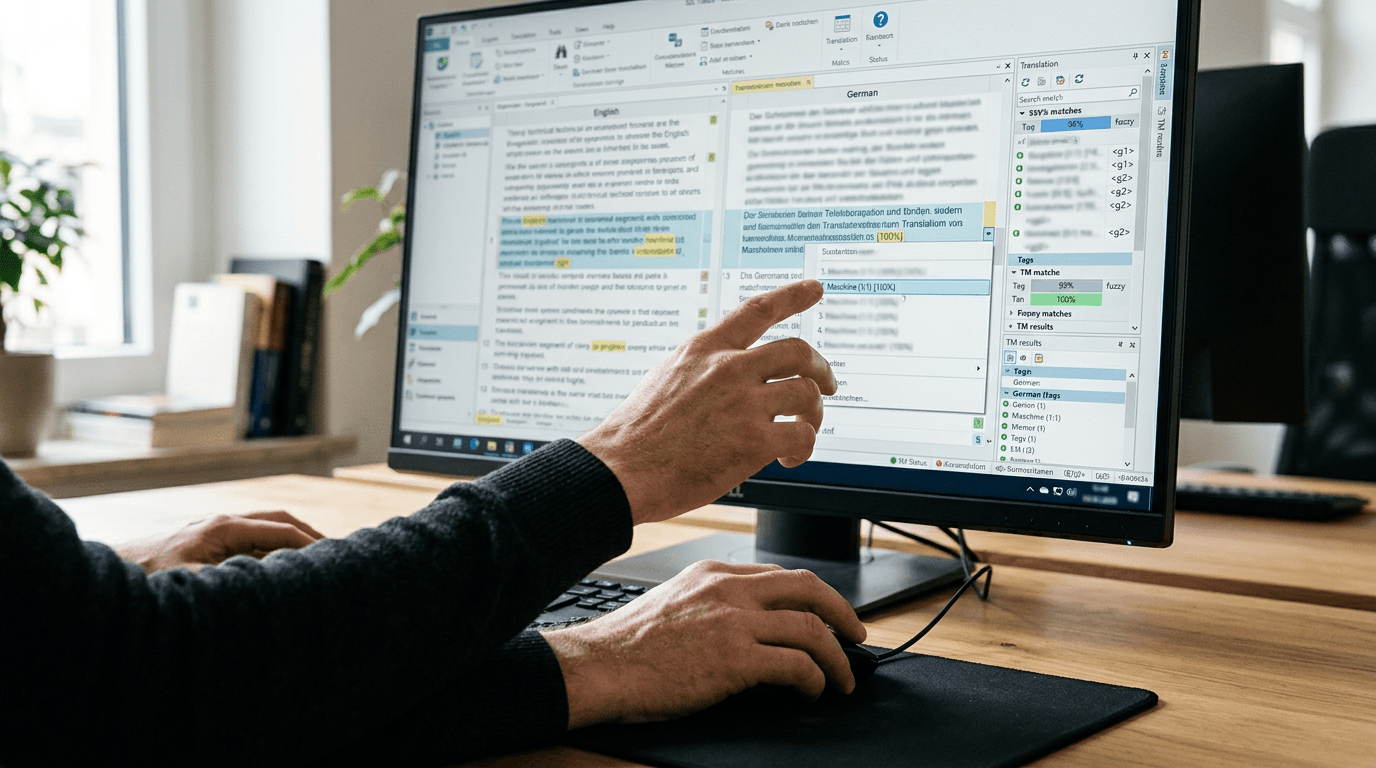
When operational leaders seek to clarify the computer-assisted translation meaning, they frequently arrive with the dangerous assumption that the software performs the actual language conversion. In reality, a Computer-Assisted Translation (CAT) tool is a specialised workbench designed exclusively for human linguists. It does not generate language; it manages repetitive text, enforces corporate glossaries, and preserves document formatting.
The core mechanism driving a CAT environment is the Translation Memory (TM). When a human translates a sentence, the software stores the source and target text as a paired segment. If that exact sentence, or a highly similar one, appears later in the document or in a future project, the TM suggests the previous translation. This prevents a human specialist from translating the same warning label or legal disclaimer twice. Alongside the TM, a Termbase (TB) operates as an interactive glossary. If a company requires the English word "monitor" to be translated as a display screen rather than a regulatory observer, the Termbase flags the word in the editor and forces the correct industry-specific terminology.
Because CAT tools parse files at the code level - extracting raw text from XLIFF or XML files while hiding the structural HTML or layout tags - linguists can focus entirely on meaning without breaking the file's architecture. The failure mode here occurs when project managers rely entirely on the software's Quality Assurance (QA) modules to catch errors. A CAT tool's QA will flag a missing full stop or a mismatched number, but it cannot tell you if the human translator has fundamentally misunderstood the tone of a safety manual.
Practical rule: Always provide human linguists with a locked, pre-approved Termbase before they begin a project in a CAT tool, as retroactively fixing terminology across thousands of stored segments is costlier than the initial translation.
Where machine translation creates liabilities without human anchors
While CAT tools assist human cognition, machine translation attempts to bypass it entirely. Neural Machine Translation (NMT) engines use deep learning models to predict the most statistically probable sequence of words in a target language based on massive training datasets. This mechanism is highly efficient for raw data triage, such as scanning hundreds of foreign-language emails during legal discovery to find a specific name or date.
However, the fundamental flaw of algorithmic processing is its inability to maintain situational context across long texts - a phenomenon known as catastrophic forgetting. Because the engine processes text in isolated vectors, it may translate the word "discharge" as the release of a patient in one paragraph, and as an electrical shock in the next. The software does not know it is translating a hospital document; it is simply reacting to localized mathematical weights. Furthermore, when NMT encounters a phrase it has not seen in its training data, it is prone to hallucination, confidently inventing fluent but entirely fabricated translations.
To mitigate these risks, the industry standard is Post-Editing Machine Translation (PEMT). In this workflow, an engine generates the initial draft, and a certified human linguist reviews it. Light post-editing merely corrects catastrophic errors to make the text comprehensible, while full post-editing polishes the output until it is indistinguishable from a human translation. If your workflow skips this human review step for external-facing documents, you are accepting the legal and reputational risks of the engine's worst probabilistic guess.
Why high-stakes fields demand more than algorithmic processing
Automated workflows collapse entirely when applied to sectors where linguistic precision is a matter of physical safety or legal compliance. To grasp what is medical translation, you must strip away the idea of simple word replacement. Medical translation involves localising pharmacological dosages, anatomical references, and patient consent forms while adhering strictly to regulatory bodies like Australia's Therapeutic Goods Administration (TGA).

For example, when a translation research facility publishes data from a multi-national clinical trial, the exact phrasing of a drug's adverse effects cannot be left to statistical probability. A machine translating "mild discomfort" might select a word in Arabic or Mandarin that implies "minor pain," potentially invalidating patient reporting standards. The broader objective in these environments is knowledge translation - the rigorous, heavily audited process of moving complex scientific findings into practical, everyday clinical application across different demographics.
This requires a mechanism called back-translation. A human specialist translates the clinical document into the target language. A second, independent linguist - who has never seen the original text - translates that new document back into the source language. A clinical review team then compares the original English with the back-translated English to identify any conceptual drift. Software cannot perform this reconciliation because it lacks the clinical expertise to judge whether two slightly different medical phrases carry the same practical consequence for a patient.
How spoken and written linguistic barriers require different tools
Many procurement officers and site managers mistakenly search for another word for interpreting when they are actually looking for translation software. In the professional language industry, these are distinct disciplines solving fundamentally different problems. Translation deals exclusively with static, written text. Interpreting deals with dynamic, in-the-moment spoken or signed communication.
While the computer assisted translation meaning applies strictly to written document workflows, spoken communication cannot be queued, segmented, and fed through a Termbase. Interpreting involves immense cognitive load; the practitioner listens to a speaker, extracts the conceptual meaning, and simultaneously or consecutively reconstructs that meaning in another language, all while reading the speaker's body language, tone, and cultural cues.
When a tourist requires immediate help navigating an airport, or an enterprise negotiates a rapid cross-border merger via video link, static file processing is useless. This is where modern workflows shift away from algorithms and rely on human connection platforms. If you require verified professionals for rapid, on-demand spoken communication, accessing a robust LINGUA FRANCA HUB connects users directly to human interpreters rather than automated text engines. Relying on an app to mechanically translate a spoken medical consultation routinely fails because voice-to-text algorithms frequently mistranscribe accents, and the subsequent text-to-text translation multiplies the initial error.
What breaks first when automating cross-cultural communication
The most severe failure mode in automated linguistics is the compromise of confidential data. Free or public-tier machine translation engines typically ingest user inputs to train future models. Feeding a proprietary engineering schematic or a patient's diagnostic history into a public algorithm is a direct breach of corporate non-disclosure agreements and healthcare privacy laws. Any secure workflow requires closed-loop enterprise infrastructure that permanently deletes source data immediately after processing.
For organisations building long-term language strategies, understanding the strict boundaries of each tool is essential. Using the right mechanism at the right time reduces friction, while applying software to human-centric problems generates liability. Ensuring that your data handling aligns with a strict Privacy Policy | Lingua Franca Hub is a mandatory step before deploying any linguistic technology.
Workflow Comparison Table
| Capability | CAT Tools (Human-Led) | Machine Translation | Human Interpreting |
|---|---|---|---|
| Primary Medium | Written text | Written text | Spoken / Signed |
| Contextual Awareness | High (Human oversight) | Low (Statistical guessing) | Maximum (Physical/Visual cues) |
| Processing Speed | Moderate | Instantaneous | Real-time (Synchronous) |
| Ideal Use Case | Manuals, contracts, interfaces | Internal data triage, high-volume logs | Medical consults, legal hearings, casual navigation |
| Data Privacy Risk | Low (if locally hosted) | High (if public tier) | Low (Confidentiality bound) |
Practical rule: Deploy algorithmic tools strictly for low-stakes data triage where speed outweighs accuracy, and mandate certified human specialists for any interaction where a linguistic error could result in physical harm, legal liability, or reputational damage.
FAQ
Does computer-assisted translation replace human translators?
No. It is a software interface built specifically for human translators. It removes the friction of repetitive formatting and terminology lookup, allowing the human to focus entirely on the nuance, tone, and cultural accuracy of the text.
When is it safe to use purely automated machine translation?
Pure machine translation is safe only for inbound, internal-facing content where the reader needs a basic, general understanding of the text, such as scanning foreign-language forum posts or internal emails. It should never be used for outbound, legally binding, or patient-facing documents without human post-editing.
How does spoken communication fit into these technological workflows?
Spoken interpreting relies on real-time human cognition and cannot be effectively managed by static translation software. While voice-to-text translation exists, its high error rate in capturing accents, idioms, and overlapping speech makes it unsuitable for professional, high-stakes environments.
Why is medical documentation treated differently than standard business text?
Medical documentation directly impacts human health and is heavily regulated by bodies like the TGA. A mistranslated marketing slogan causes embarrassment; a mistranslated medication dosage or surgical instruction causes physical harm, necessitating rigorous human back-translation and clinical reconciliation.